
You’re eating the same. You’re exercising the same. So why is your belly suddenly getting bigger?
This is something I hear from women all the time:
“I haven’t changed anything, but my body is responding completely differently.”
And there may be a physiological reason. Your diet may not have changed.
But your body did.
I’ve been there – I get it.
As estrogen declines during menopause, changes can occur in where you store fat, how much muscle you carry, how much energy you use and how sensitive your body is to insulin.
That doesn’t mean menopause automatically causes weight gain or insulin resistance. But it does mean the strategies that worked at 35 may not work as well at 45+.
Why does belly fat increase in menopause?
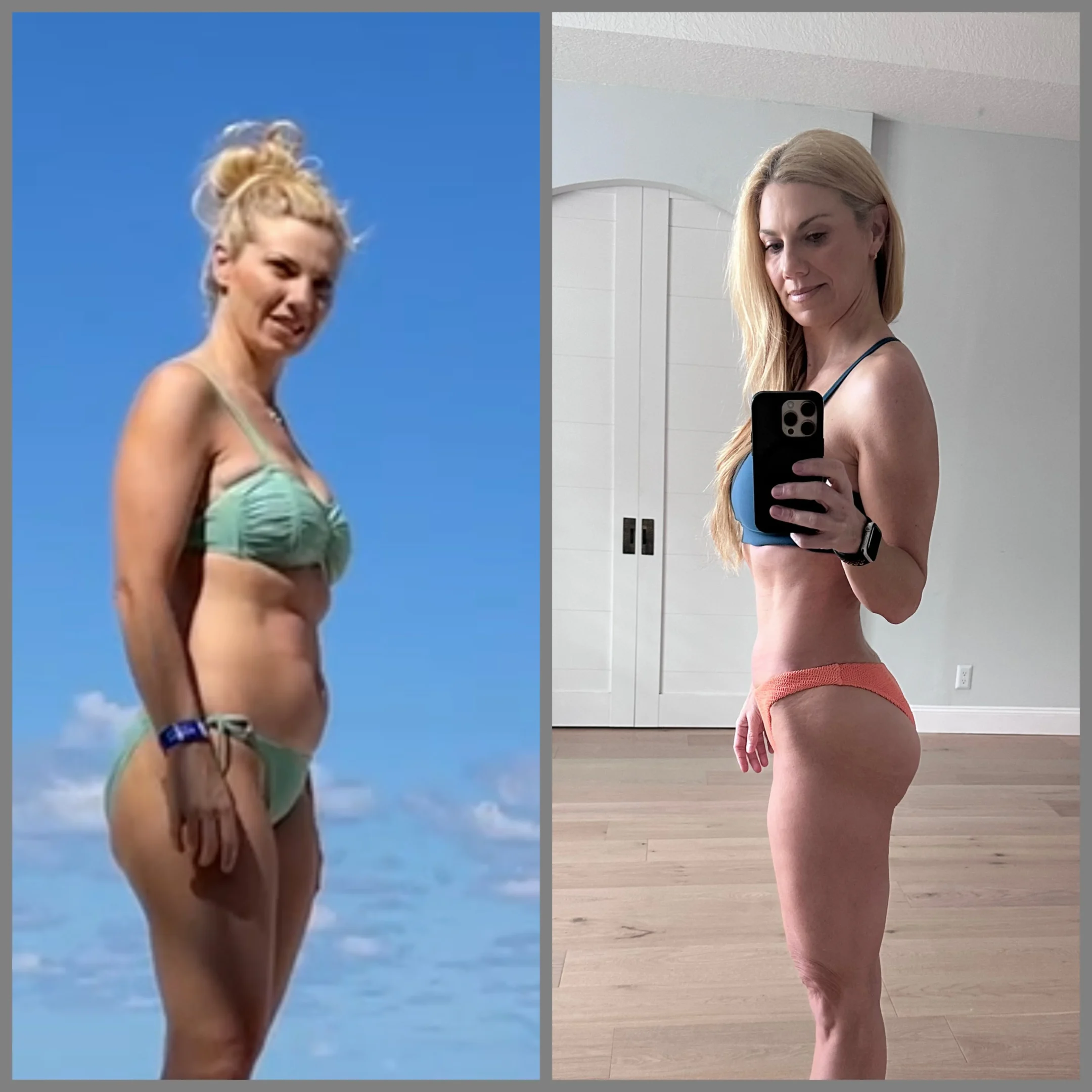
Before menopause, women tend to store more fat underneath the skin around the hips and thighs. As estrogen declines, fat distribution tends to shift toward the abdomen.
Large studies following women through menopause have shown that fat gain accelerates while lean muscle begins to decline during the menopause transition.
Interestingly, overall body weight doesn’t necessarily increase dramatically at the same time.
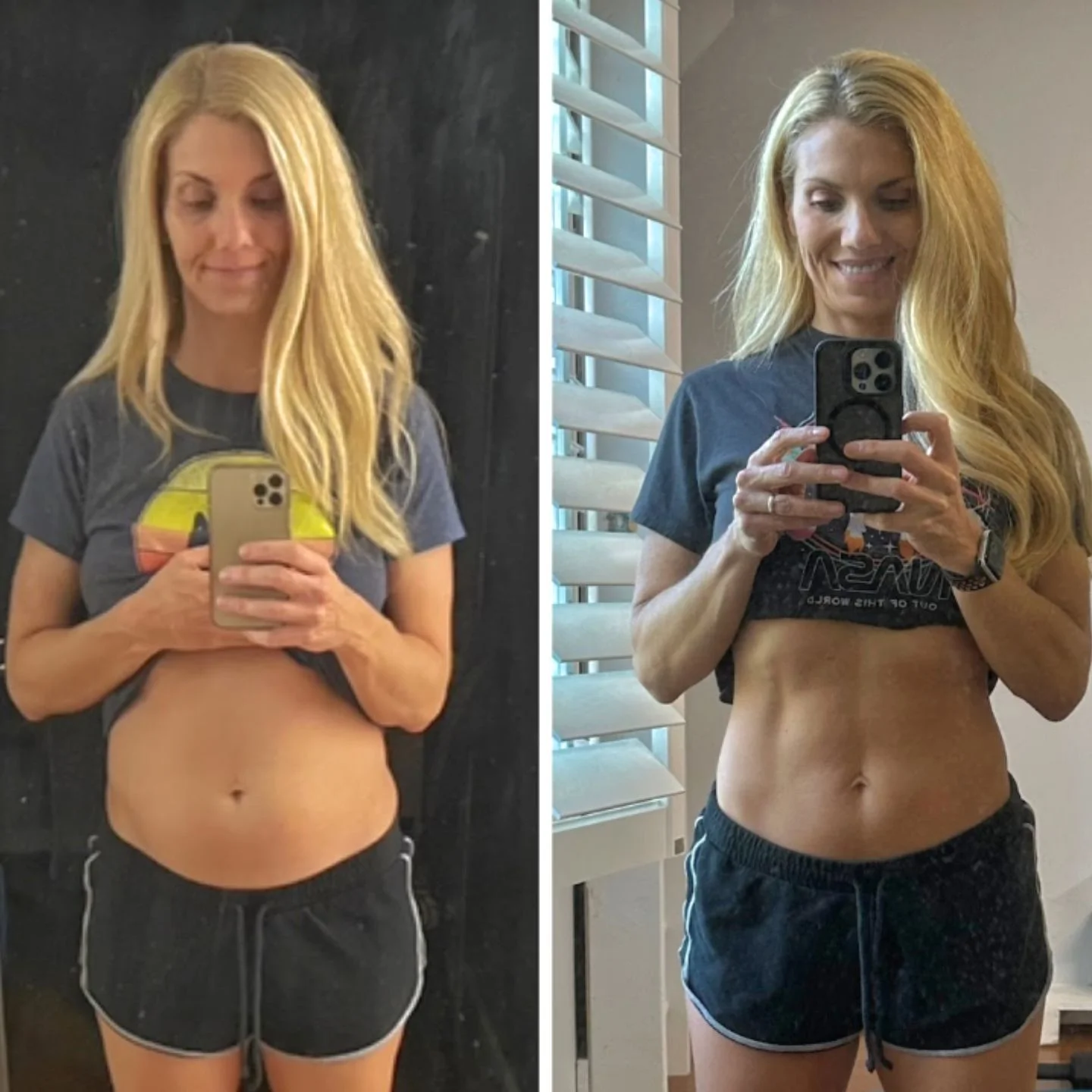
This is why you may weigh close to the same amount but notice that your waistline and body shape have changed.
What does this have to do with insulin?
Insulin helps move glucose from your bloodstream into your cells, especially your muscles, where it can be used for energy or stored for later.
When your cells don’t respond as well to insulin, your body has to produce more of it to get the same job done.
That’s insulin resistance.
One thing strongly associated with poorer insulin sensitivity is visceral fat, the deeper abdominal fat surrounding your organs. So menopause doesn’t simply flip an “insulin resistance switch.” Instead, it may look more like this:
Estrogen declines → fat distribution changes → more visceral fat can accumulate → insulin sensitivity may worsen.
Not every woman becomes insulin resistant, but changes in abdominal fat can increase the risk.
Muscle is part of the story too
Muscle isn’t just important for strength. It’s one of the major places your body sends glucose after you eat.
During menopause, women can begin losing lean muscle. Less muscle, combined with less daily movement, can mean your body handles energy differently than it did years ago.
This is one reason strength training becomes so important in midlife.
We aren’t just training to burn calories.
We are protecting metabolically active tissue.
“But I’m eating the same amount.”
You may be. But your body’s energy needs may have changed.
Research suggests that total daily energy expenditure can decrease as women move through menopause. That doesn’t mean menopause suddenly “destroys your metabolism.”
Some of the decline appears to come from changes in muscle mass, physical activity and how much we move throughout the day.
Each change may be small. But over several years, those small changes add up. The amount of food that once perfectly matched your energy needs may now be slightly more than your body uses.
You didn’t necessarily start eating more. Your body changed.
What about dietary fat?
Eating fat does not automatically make you insulin resistant.
But when we consistently consume more energy than our body needs, that excess has to be stored somewhere.
Research also suggests that the type of fat matters.
In controlled overfeeding studies, excess saturated fat produced significantly more liver and visceral fat than excess unsaturated fat.
That doesn’t mean you need to fear fat. It means food quality matters.
And whenever possible, I prefer getting fats from whole foods rather than isolated oils and heavily processed foods.
Think:
olives instead of using olive oil.
Eating whole foods gives you fiber, protein, vitamins, minerals, and other nutrients that an isolated oil doesn’t provide. Plus, whole foods fill your stomach and make you feel fuller faster!
The goal isn’t to eliminate fat. It’s to make the majority of your diet come from nutrient-dense, minimally processed whole foods.
If you reached your late 40s or 50s and thought:
“What happened to my body?”
You’re not imagining the changes. Your hormonal environment changed. Where you store fat may have changed.
Your muscle mass may have changed. Your daily energy needs may have changed. And your insulin sensitivity may have changed along with them.
This doesn’t mean you need to eat less and exercise more aggressively. It means you may need to eat and train differently.
Your diet may not have changed. But your body did.
Learn how to work with your menopausal body
This is exactly why I created my MenoMagic program and protocol.
MenoMagic teaches you how to eat and train for your menopausal body, with a focus on the things that become increasingly important in midlife: building and maintaining muscle, supporting metabolic health, eating nutrient-dense whole foods, walking, moving more and training in a way that works with your changing body instead of constantly fighting against it.
You don’t need another extreme diet.
And you don’t need to punish yourself with harder workouts.
You need a strategy designed for your body right now. Give MenoMagic 30 days, and I promise you’ll start to see the shift!
Join today and get 25% off any membership using the code BURN25

Click here to check out my MenoMagic Program!
References
- Greendale GA, et al. Changes in Body Composition and Weight During the Menopause Transition. JCI Insight. 2019;4(5):e124865. PMID: 30843880.
- Lovejoy JC, et al. Increased Visceral Fat and Decreased Energy Expenditure During the Menopausal Transition.International Journal of Obesity. 2008;32:949-958. PMID: 18332882.
- Duval K, et al. Effects of the Menopausal Transition on Energy Expenditure: A MONET Group Study. European Journal of Clinical Nutrition. 2013;67:407-411. PMID: 23422924.
- Luukkonen PK, et al. Saturated Fat Is More Metabolically Harmful for the Human Liver Than Unsaturated Fat or Simple Sugars. Diabetes Care. 2018;41:1732-1739. PMID: 29844096.
- Rosqvist F, et al. Overfeeding Polyunsaturated and Saturated Fat Causes Distinct Effects on Liver and Visceral Fat Accumulation in Humans. Diabetes. 2014;63:2356-2368. PMID: 24550191.
This article is for educational purposes and is not intended to diagnose or treat insulin resistance, diabetes or another medical condition.
How was your experience?